Showing posts with label Wise Men figurines. Show all posts

Wednesday, January 6, 2010

The Three Kings on Epiphany


The kings of Tarshish and of distant shores
will bring tribute to him;
the kings of Sheba and Seba
will present him gifts
Psalms 72:10


January 6 is celebrated as the Feast of Epiphany, in keeping with the tradition that the Three Wise Men from the East arrived to worship the Baby Jesus on this day. It is called Epiphany to express the “appearing” of the Saviour to the Gentiles.

"The people that walked in darkness
have seen a great light:
they that dwell in the land of the shadow of death,
upon them hath the light shined.”
Isaiah 9:2


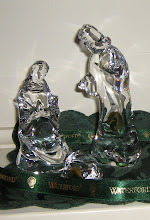
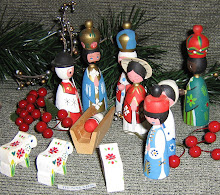
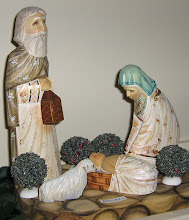
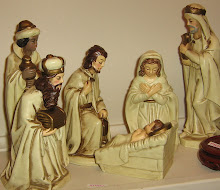
The wise men figures are usually the ones that are dressed in fabulous robes and head dress. More nativity scenes include these three figures than the shepherds. There are even designs of the three as a stand-alone artifacts. A new section of the nativity gallery is a display of wise men figurines and ornaments.
We see various materials -- plastic canvas, burlap and sequins,

Various sizes...
Various formats


Ornaments are hung on a lighted garland:


A small book in the collection is The Gifts of the Magi: Gold and Frankincense and Myrrh, from the Metropolitan Museum of Art, NY.
In the slipcase along with the book are samples of the wise men's gifts:
Gold, Frankincense, and Myrrh:

These precious gifts provided financial assistance as the Family had to flee to Egypt. But they also symbolized tribute to the long awaited Messiah from foreign lands:
The kings of Tarshish and of distant shores
will bring tribute to him;
the kings of Sheba and Seba will present him gifts
Psalms 72:10 NIV

One of my Christmas gifts from my sister and brother-in-law was The Original Gifts of Christmas, a folder from the Holy Land Experience in Daytona, FL. Inside are samples of the three gifts.


They also sent me an ornament with the Wise Men and the Baby Jesus:
I have a particular fascination with the three wise men as part of the nativity story. I love to consider the Bible texts that show God’s interest in people from all parts of the world.
“ ‘Turn to me and be saved, all you ends of the earth’ ”
Isa. 45: 22 NIV

For God so loved the world
that he gave his one and only Son,
that whoever believes in him shall not perish
but have eternal life
John 3:16 NIV


He is the atoning sacrifice for our sins,
and not only for ours
but also for the sins of the whole world.
1John 2:2 NIV


Here there is no Greek or Jew,
circumcised or uncircumcised,
barbarian, Scythian, slave or free,
but Christ is all, and is in all.
Colossians 3:11 NIV


The biggest news of the nativity story is that the Baby Jesus was sent to make an even playing field and to offer eternal success for any person who chooses Him as their Saviour.


For more Word-filled Wednesday posts, please go to Amy at The 160 Acre Wood.

Tuesday, January 6, 2009

Wise Men Still Seek Him

January 5th is the eleventh day since Christmas Day or Twelfth Night, the Eve of the feast of Epiphany. January 6th is called Epiphany or the appearing. Western Christian tradition holds this as the day the Wise Men arrived at the place where the Baby Jesus was in Bethlehem. This is considered as God appearing to the Gentiles, while the Shepherds represented the nation of Israel. Matthew 2:1-12 tells the story. It ends on a joyful note:

9After they had heard the king, they went on their way, and the star they had seen in the east[e] went ahead of them until it stopped over the place where the child was. 10When they saw the star, they were overjoyed. 11On coming to the house, they saw the child with his mother Mary, and they bowed down and worshiped him. Then they opened their treasures and presented him with gifts of gold and of incense and of myrrh. 12And having been warned in a dream not to go back to Herod, they returned to their country by another route." Matthew 2:9-12 NIV

The three Wise Men or Magi are usually the most elaborate and highly decorated figures in the nativity scenes. They wear great robes, stately headdress such as crowns, and carry rich gifts.
Here are a few examples of Magi from various sets in the collection:


The three Wise Men represent various races or nations. Note the different headress on each figurine:


In this set each figure has a different aspect in worship -- standing, kneeling and prostrate on the floor:


A lot of Wise Men figurines are designed as a stand-alone motif and are not part of a nativity set. Examples of Magi as stand-alone sets are:

A ceramic set from Japan

A vintage set of cardboard, burlap and gemtone embellishments

Another vintage cardboard set with Asian features
A one-piece set from Puerto Rico


In Spain and in Latin American countries January 6 is a special holiday, the 'day of the three kings.' There are street processions, giving of gifts, and other festive activity.

Here are two prints done by Puerto Rican artist, Michelle Yegros, both focussing on the Magi.
"Magos en la Capilla" (Magi in the Chapel), a digital serigraph on acid-free linen paper, done in 2003. The actual printed image is about 7" x 6.5" on 11 x 8.5 paper.


"Sueno con los Reyes"(Dream of the Magi), a digital serigraph printed on acid-free linen paper. The actual printed image is about 7" x 6.5" on 11 x 8.5 paper.


As a final note, here is a happy song relating to the joy of the wise men when they saw the star after leaving Jerusalem and Herod’s interview with them. It is from YouTube with The Martins singing "They Rejoiced With Exceeding Great Joy."
http://www.youtube.com/watch?v=TdvtOk2-i8s
Here are the lyrics:
Over the mountains and valleys
had led them each night
A star of most radiant light.
The wise men rejoiced as they journeyed afar
To behold such a beautiful star.

When they saw the star
They rejoiced with great joy
When they saw the star
They rejoiced
When they saw the star
They rejoiced with great joy
They rejoiced with exceeding great joy.

Others saw the star but they followed it not
To them it would come and would pass.
The wise men kept trusting with all of their hearts
That the star would find the baby at last.
And when they saw the star
They rejoiced with great joy
When they saw the star
They rejoiced
When they saw the star
They rejoiced with great joy
They rejoiced with exceeding great joy.

During 2009 may we each continue to seek and to find the Savior. Our joy will be great as we behold Him.

Sunday, November 2, 2008

Notable Features Commonly Found in Nativity Sets, Part I

In this post I will deal with about ten features commonly found in nativity scenes. These are conventions which Western ideas or attitudes about the birth of Christ as given in the Biblical accounts.


The first of these is Mary kneeling, worshipping Jesus. While some show Mary holding the newborn, most will have her in an adoring pose.


A second convention has Baby in a manger box of some kind. He is usually scantily clad or naked, unlike the Biblical acount where He is snugly wrapped in swaddling cloths.


Most often Joseph is portrayed holding a staff or a lantern.


A fourth and very common feature is the Wise Men figures. Most scenes show three Wise Men bringing gifts and worshipping the Babe.


Another important feature relating to the Wise Men is their Elaborate dress and resplendent accoutrements, including one or more camels. The Wise Men are often the most costly component of the nativity set. While the three piece Holy Family might be have most attractive price, the three wise men will cost considerably more due to the work which has been put on their elaborate costumes


In Part II we will consider a few more features common to most nativity sets.